Popular Fallacy: "Welfare" is somehow un-American.
Reset: "Welfare" is one of the reasons the founding fathers formed a government in the first place. As the preamble to the Constitution tells us: "We the People of the United States, in order to form a more perfect Union, establish Justice, insure domestic Tranquility, provide for the common defence, promote the general Welfare, and secure the Blessings of Liberty to ourselves and our Posterity, do ordain and establish this Constitution for the United States of America."
That's "promote the general welfare." Not "clear a space for efficient markets." And it's a purpose mentioned even before securing the blessings of liberty.
Popular Fallacy: "Big government" is inherently bad.
Reset: Eliminating the armed forces and the Department of Defense would cut the size of the federal government and its budget a whole bunch. Add Medicare, Social Security, and the Federal Deposit Insurance Corporation to the trash pile, and you're left with a government that's less than half its current size.
And yet nobody suggests those moves. Because everybody understands that if we want government to do something, and it needs to get bigger to do it, we're all in favor.
So when speakers calling themselves "conservative" gripe about a government program and suggest that they've identified an objective evil when they label it "big government," it's worth remembering that they have done no such thing, and that "big government" is objectively neutral. What they've actually done is stated a subjective preference, and that preference is usually that they not be taxed to have government perform that function.
Popular Fallacy: Government can't be trusted to do anything right; to get it done well, the private sector has to do it.
Reset: Some tasks are too big for private enterprise. Others aren't sure enough money-makers to attract private investors. If society needs those things done anyway, there's only one recourse.
Which is why government does the most important job a society can assign: defending its existence.
It is also why you can count on street lights to manage traffic at busy urban intersections and have a reasonable expectation that the driver approaching the intersection from your right has been taught to interpret red and green lights the same way you do.
A corporation couldn't afford to develop and build state-of-the-art defense systems if it had to count on discretionary private funds to pay for them. And society couldn't afford having the rules of the road known only by those who were willing and able to buy the education.
It's not like private enterprise is the most effective way of getting things done, either. The corporation's reason for being is to make maximum profit for its shareholders. If it can do that by building a better mousetrap, defense system, or driver education program, so be it. But if it can make more cash by providing substandard product while driving away the competition or winning the advertising battle, that'll be the chosen route. And if it can't make a profit on mousetraps, weapons, or drivers' ed, they won't get done at all.
The bottom line is that profit-driven corporations are all about promoting their own specific welfare. If they do anything for the general welfare, that's just a happy coincidence.
Popular Fallacy: Social welfare programs are nothing more than attempts to appease the over-stimulated do-gooder impulses of bleeding-heart liberals.
Reset: Social welfare programs are capitalism's best and most practical hope for self-preservation.
The McCarthyism of the 1950s uncovered communist flirtations started in the 1930s, and communism was popular in the 1930s because of depression-era poverty. When enough people start thinking that the current system is only offering them a life that's miserable, they start imagining ways to do away with the current system. World history shows what happens when the powers that be try to squash those imaginings: sooner or later, the little people employed to do the squashing realize that people they'll never be like are demanding that they lock up or shoot little people just like themselves. Before you know it, the powers that be have gone the way of Louis XVI and Marie Antoinette, and your country is being run by somebody with a military title.
Fortunately, America didn't handle its potential unrest that way.
New Deal social programs, whether effective or not, offered at least the promise that the lifestyle the average American could expect if he hit rock bottom wouldn't be so bad. The extra promise offered by the GI Bill and the boom that followed the Second World War made it easy for millions of working-class men to believe that hard work could give them middle class education, income, lifestyles, and respectability.
By the 1950s, the soldier or cop from next door didn't need to resent the fact that he had to defend some muckety-muck from the kid on the corner; he, too, could be that muckety-muck in a matter of a few years, so he could understand the need to keep that corner kid in check. When society keeps him thinking that he has a vested interest in the status quo, and that he isn't just some chump defending the interests of a few rich guys, society is doing itself a big favor.
Showing posts with label What's Wrong. Show all posts
Showing posts with label What's Wrong. Show all posts
Wednesday, September 2, 2009

Sunday, August 23, 2009
What's Wrong: Something You Really Couldn't Say Today
Two months before signing into law the Voting Rights Act of 1965, President Lyndon Johnson gave the commencement address at Howard University in Washington. To read his words in 2009 is to be stunned at how far away from his sentiments America has come:
The voting rights bill will be the latest, and among the most important, in a long series of victories. But this victory--as Winston Churchill said of another triumph for freedom--"is not the end. It is not even the beginning of the end. But it is, perhaps, the end of the beginning."
The voting rights bill will be the latest, and among the most important, in a long series of victories. But this victory--as Winston Churchill said of another triumph for freedom--"is not the end. It is not even the beginning of the end. But it is, perhaps, the end of the beginning."
That beginning is freedom; and the barriers to that freedom are tumbling down. Freedom is the right to share, share fully and equally, in American society--to vote, to hold a job, to enter a public place, to go to school. It is the right to be treated in every part of our national life as a person equal in dignity and promise to all others.
But freedom is not enough. You do not wipe away the scars of centuries by saying: Now you are free to go where you want, and do as you desire, and choose the leaders you please.
You do not take a person who, for years, has been hobbled by chains and liberate him, bring him up to the starting line of a race and then say, "you are free to compete with all the others," and still justly believe that you have been completely fair.
Thus it is not enough just to open the gates of opportunity. All our citizens must have the ability to walk through those gates.
This is the next and the more profound stage of the battle for civil rights. We seek not just freedom but opportunity. We seek not just legal equity but human ability, not just equality as a right and a theory but equality as a fact and equality as a result.
* * *
The Negro, like . . . others, will have to rely mostly upon his own efforts. But he just can not do it alone. For they did not have the heritage of centuries to overcome, and they did not have a cultural tradition which had been twisted and battered by endless years of hatred and hopelessness, nor were they excluded--these others--because of race or color--a feeling whose dark intensity is matched by no other prejudice in our society.
Nor can these differences be understood as isolated infirmities. They are a seamless web. They cause each other. They result from each other. They reinforce each other.
Much of the Negro community is buried under a blanket of history and circumstance. It is not a lasting solution to lift just one corner of that blanket. We must stand on all sides and we must raise the entire cover if we are to liberate our fellow citizens.
* * *
Men are shaped by their world. When it is a world of decay, ringed by an invisible wall, when escape is arduous and uncertain, and the saving pressures of a more hopeful society are unknown, it can cripple the youth and it can desolate the men.
There is also the burden that a dark skin can add to the search for a productive place in our society. Unemployment strikes most swiftly and broadly at the Negro, and this burden erodes hope. Blighted hope breeds despair. Despair brings indifferences to the learning which offers a way out. And despair, coupled with indifferences, is often the source of destructive rebellion against the fabric of society.
There is also the lacerating hurt of early collision with white hatred or prejudice, distaste or condescension. Other groups have felt similar intolerance. But success and achievement could wipe it away. They do not change the color of a man's skin. I have seen this uncomprehending pain in the eyes of the little, young Mexican-American schoolchildren that I taught many years ago. But it can be overcome. But, for many, the wounds are always open.
Perhaps most important--its influence radiating to every part of life--is the breakdown of the Negro family structure. For this, most of all, white America must accept responsibility. It flows from centuries of oppression and persecution of the Negro man. It flows from the long years of degradation and discrimination, which have attacked his dignity and assaulted his ability to produce for his family.
This, too, is not pleasant to look upon. But it must be faced by those whose serious intent is to improve the life of all Americans.
Only a minority--less than half--of all Negro children reach the age of 18 having lived all their lives with both of their parents. At this moment, tonight, little less than two-thirds are at home with both of their parents. Probably a majority of all Negro children receive federally-aided public assistance sometime during their childhood.
The family is the cornerstone of our society. More than any other force it shapes the attitude, the hopes, the ambitions, and the values of the child. And when the family collapses it is the children that are usually damaged. When it happens on a massive scale the community itself is crippled.
So, unless we work to strengthen the family, to create conditions under which most parents will stay together--all the rest: schools, and playgrounds, and public assistance, and private concern, will never be enough to cut completely the circle of despair and deprivation.
* * *
There is no single easy answer to all of these problems.
Jobs are part of the answer. They bring the income which permits a man to provide for his family.
Decent homes in decent surroundings and a chance to learn--an equal chance to learn--are part of the answer.
Welfare and social programs better designed to hold families together are part of the answer.
Care for the sick is part of the answer.
An understanding heart by all Americans is another big part of the answer.
And to all of these fronts--and a dozen more--I will dedicate the expanding efforts of the Johnson administration.
What's Wrong: Things That Can't Be Said Today
Modern American politics, at least at the national level, is mostly about electing people who are gonna help me get mine, and about defeating people who are trying to help you get mine. There's a little wiggle room in that principle, of course. The rich can be taxed extra without excessive fallout, provided that the threshold for "rich" is shown to be high enough. But you can't even say you're prepared to raise taxes on the rich without showing most folks they'll be getting a share of the proceeds, unless the beneficiaries are in a few tiny categories of sacred cattle, like seniors, the military, law enforcement and firefighters. The general idea of using government resources to help anybody else is now considered so un-American that most politicians shy away from ever suggesting any such thing.
That wasn't always the case, though. American politicians used to be able to say that government needed to do more for some subsection of the population. To calibrate just how far we've come from that direction, imagine a modern candidate for president or U.S. Senate saying any of the following:
1. "I stand for the square deal. But when I say that I am for the square deal, I mean not merely that I stand for fair play under the present rules of the games, but that I stand for having those rules changed so as to work for a more substantial equality of opportunity and of reward for equally good service."
2. "We grudge no man a fortune in civil life if it is honorably obtained and well used. It is not even enough that it should have gained without doing damage to the community. We should permit it to be gained only so long as the gaining represents benefit to the community. This, I know, implies a policy of a far more active governmental interference with social and economic conditions in this country than we have yet had, but I think we have got to face the fact that such an increase in governmental control is now necessary."
3. "The really big fortune, the swollen fortune, by the mere fact of its size acquires qualities which differentiate it in kind as well as in degree from what is possessed by men of relatively small means. Therefore, I believe in a graduated income tax on big fortunes, and in another tax which is far more easily collected and far more effective - a graduated inheritance tax on big fortunes, properly safeguarded against evasion and increasing rapidly in amount with the size of the estate."
4. "The man who wrongly holds that every human right is secondary to his profit must now give way to the advocate of human welfare, who rightly maintains that every man holds his property subject to the general right of the community to regulate its use to whatever degree the public welfare may require it."
5.“A strict application, let us say, of economic theory, at least as taught by Adam Smith, would be, ‘Let these people take care of themselves; during their active life they are supposed to save enough to take care of themselves.’ In this modern industry, dependent as we are on mass production, and so on, we create conditions where that is no longer possible for everybody. So the active part of the population has to take care of all the population, and if they haven’t been able during the course of their active life to save up enough money, we have these systems.”
The speakers--
Quotes 1-4:

Quote 5:

Those sentiments are pretty moderate, though, compared to another comment so lengthy and so shockingly out of line with currently accepted expression that it deserves its own entry . . .
That wasn't always the case, though. American politicians used to be able to say that government needed to do more for some subsection of the population. To calibrate just how far we've come from that direction, imagine a modern candidate for president or U.S. Senate saying any of the following:
1. "I stand for the square deal. But when I say that I am for the square deal, I mean not merely that I stand for fair play under the present rules of the games, but that I stand for having those rules changed so as to work for a more substantial equality of opportunity and of reward for equally good service."
2. "We grudge no man a fortune in civil life if it is honorably obtained and well used. It is not even enough that it should have gained without doing damage to the community. We should permit it to be gained only so long as the gaining represents benefit to the community. This, I know, implies a policy of a far more active governmental interference with social and economic conditions in this country than we have yet had, but I think we have got to face the fact that such an increase in governmental control is now necessary."
3. "The really big fortune, the swollen fortune, by the mere fact of its size acquires qualities which differentiate it in kind as well as in degree from what is possessed by men of relatively small means. Therefore, I believe in a graduated income tax on big fortunes, and in another tax which is far more easily collected and far more effective - a graduated inheritance tax on big fortunes, properly safeguarded against evasion and increasing rapidly in amount with the size of the estate."
4. "The man who wrongly holds that every human right is secondary to his profit must now give way to the advocate of human welfare, who rightly maintains that every man holds his property subject to the general right of the community to regulate its use to whatever degree the public welfare may require it."
5.
The speakers--
Quotes 1-4:
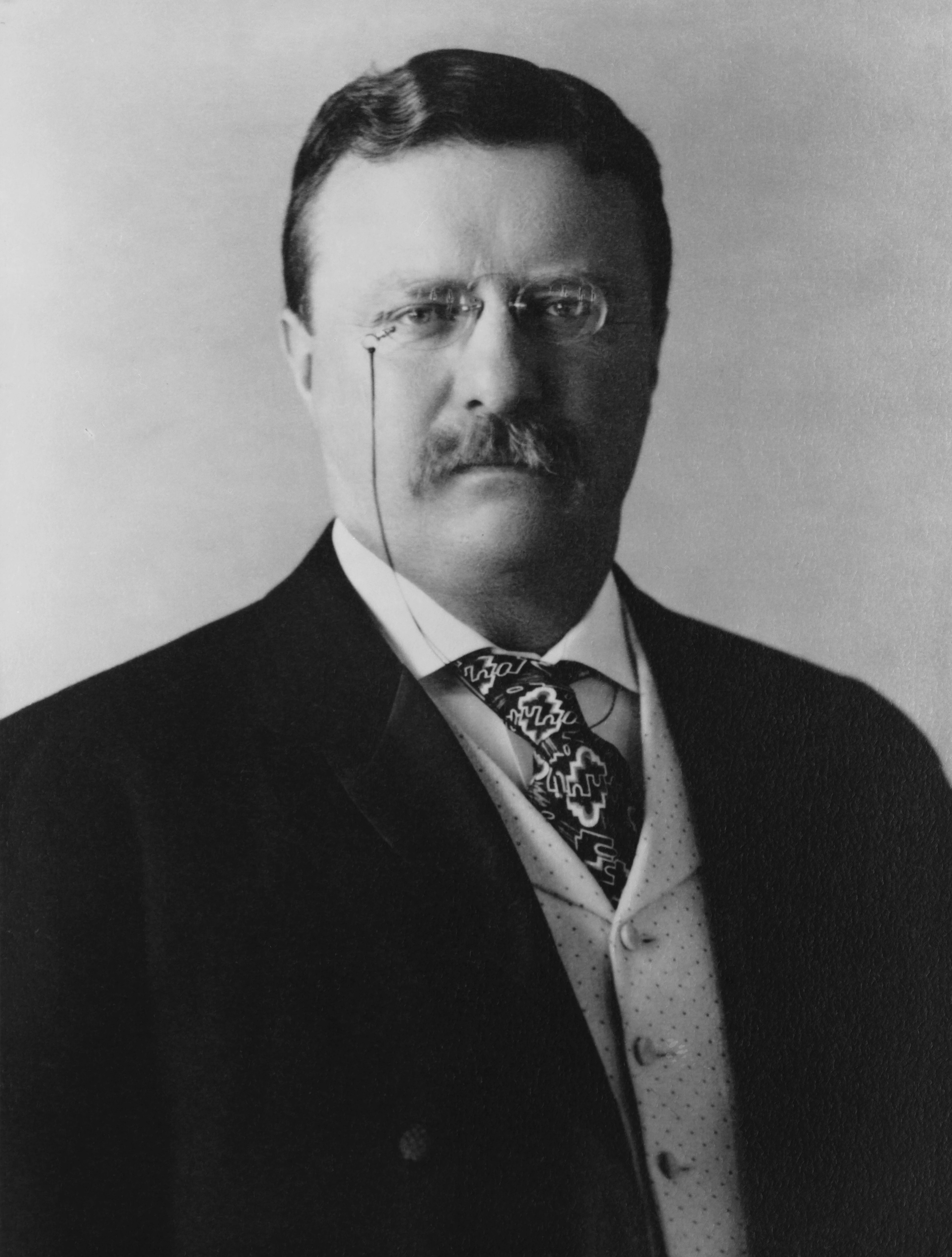
Quote 5:

Those sentiments are pretty moderate, though, compared to another comment so lengthy and so shockingly out of line with currently accepted expression that it deserves its own entry . . .
Friday, August 21, 2009
What's Wrong: Politics As Tribalism


Ex-Washington D.C. mayor Marion Barry.
Ex President of the United States George W. Bush.
Flip sides of the same coin. And proof positive of the nature of politics in America: tribalism.
I'm voting for the candidate who is most likely to be for me. I'm voting against the candidate who is most likely to be for you.
The competence of the opposition isn't particularly relevant. Even if the guy who is for me hasn't done a good job, I'd rather vote for him than the apparently competent guy who is for you.
In fact, a scoundrel, crook or idiot who is for me is better than a righteous, intelligent go-getter who is for you. Flaws in the candidate who's for you are crucial; those same traits in the guy who's for me might be virtues. If they're not virtues, they're forgiveable, and I'm mad at you for bringing them up.
Even if the guy who's "for me" isn't really for me; even if he's really for himself and his cronies, if he's willing to publicly accept the label of being for me, he's a better choice than the guy who's for you.
I'm horrified that people like you would continue to vote for guys like your guy despite all the evidence that he is the wrong man for the job. In fact, you must be stupid or worse to continue to support the likes of him. Meanwhile, I'm going to continue to vote for my guy, pretty much without any regard for what you might say or show about him.
------------------
All of that, by the way, is fine, to a point.
Where is America, in relation to that point?
To be continued . . .

Subscribe to:
Posts (Atom)